Your Gym in 2030 Won't Look Anything Like It Does Today. Here's What's Coming.
The Future of Fitness Is Already Here
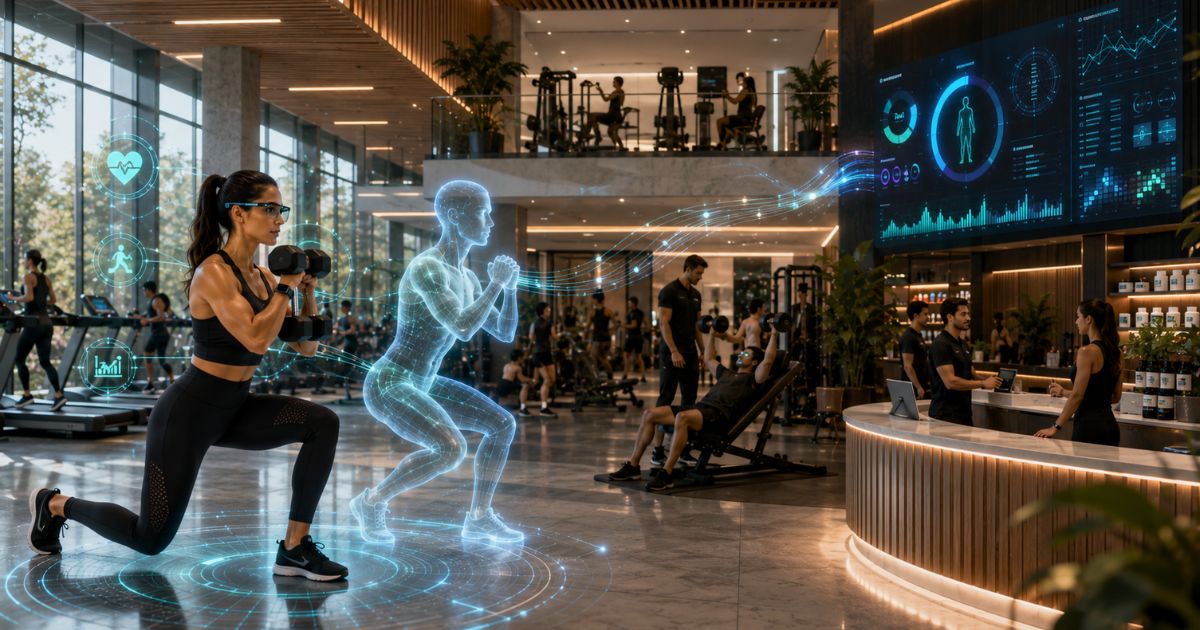
Picture this: you walk into your gym, throw on a pair of AR glasses, and a perfect-form avatar appears next to you as you squat. Your smartwatch is quietly feeding your heart rate to your AI coach, which just told you to drop the weight because you're creeping into the anaerobic zone. Later, it pings you: "You're 65% likely to strain your lower back in the next two weeks. ” This isn’t science fiction; it’s the future of fitness, where technology, data, and personalization converge to transform how we train, recover, and stay healthy.
That's not a scene from a sci-fi movie. It's a realistic snapshot of where fitness is headed in the next five years.
For most of the last decade, "AI in fitness" meant a step counter and a heart rate strap. Today it means real-time form correction, personalized programming, and gyms that can predict who's about to quit before they do. And the pace is only accelerating.
So let's talk about what's actually coming, when it's coming, and — if you run a gym — what you should be doing about it right now.
Where AI in Fitness Stands Today
Before we get to the future, it's worth being honest about the present. Current AI is genuinely useful, but it's still mostly reactive — it tells you what already happened, not what's about to happen. A few things it's doing well right now:
· Form feedback via computer vision, accurate 85–95% of the time on major movements
· Personalized programming that adjusts workouts based on performance
· Predictive health flags like churn risk (enterprise-level, mostly used by gym operators, not members)
· Engagement tools — class recommendations, streaks, badges, personalized nudges
· Business intelligence for revenue and marketing optimization
· Basic nutrition coaching through macro tracking and meal suggestions
Useful stuff. But mostly disconnected — a bunch of individual features rather than one integrated system. That's about to change.
The Future Starts Today
Here’s the part most “future of fitness” articles skip: a chunk of this isn’t five years out. It’s already live, and it’s already running inside Fitzpot. The gap between where the industry stands and where it’s headed is smaller than it looks — and it’s closing fast.
Today’s Fitzpot Capabilities:
· AI CRM
· AI Recommendations
· AI Business Intelligence
· Relationship Health Score
· AI Marketing Automation
· AI Wellness Companion
Tomorrow:
· Wearables
· Smart equipment
· Genetics
· AR
· Neural interfaces
That second list is exactly what the next section digs into — the seven shifts that take fitness from where Fitzpot already stands today to where the whole industry is headed next.
Seven Shifts That Are Actually Coming
1. Your wearable and your AI coach start talking to each other (1–2 years out)
Right now your Apple Watch tracks your heart rate, and your fitness app analyzes your workout — separately. Soon, they'll be one conversation. Your AI coach will see your heart rate spike into the anaerobic zone mid-set and tell you to back off in real time, or notice your heart rate variability is low and steer you toward a recovery day instead of a heavy squat session.
2. Equipment gets smart (2–3 years out)
Dumbbells today are, well, dumb. That changes. Smart dumbbells will track weight, rep speed, and control, then flag fatigue before you do ("your rep speed just dropped 15% — maybe skip that last set"). Smart machines will auto-adjust resistance the moment your form starts to break down.
3. Training becomes immersive (2–4 years out)
Think AR glasses turning your squat session into something closer to a video game — a form-perfect avatar next to you, live feedback overlaid on your movement, and motivational cues cheering you toward a new PR. Early tests suggest this kind of immersive coaching can boost engagement significantly and speed up how fast people learn new movements.
4. AI starts predicting injuries before they happen (1–3 years out)
Instead of just tracking who's about to cancel their membership, AI will start watching for the early warning signs of injury — form breakdown, sudden volume spikes, poor recovery signals — and step in before something goes wrong.
5. Your genetics join the equation (2–4 years out)
Combine genetic data (muscle fiber type, recovery speed, nutrient metabolism) with your training history, and AI can build a program actually suited to your biology — not just a generic template. Someone genetically wired for explosive strength but stuck in a hypertrophy-focused program might get a very different recommendation once genetics enter the picture.
6. AI coaches start sounding like actual coaches (2–5 years out)
Instead of rigid if-this-then-that logic, AI coaching starts to feel like a real conversation. Tell it you're bored with your program, and it responds with real alternatives based on your data — not a canned response.
7. Neural interfaces (5–10 years out, admittedly speculative)
This is the furthest-out one, but worth watching: brain-computer interfaces that could detect fatigue, motivation dips, or form breakdown before you're even consciously aware of them. Neuralink-style tech is already in early human trials, so it's not pure fantasy — just early.
Why This Actually Matters for Gyms (Not Just Tech Enthusiasts)
This isn't just a "cool tech" story — it's a business opportunity for anyone running a gym or fitness brand:
· Premium AI tiers. Offer a standard membership and a premium one that bundles AI coaching, genetic analysis, and recovery tracking. Even a modest 10–15% upgrade rate can add tens of thousands in annual revenue for a mid-sized gym.
· Franchise consistency at scale. Train AI on your best coaches' methods at HQ, then deploy that expertise to every location — no more quality dilution as you grow.
· Corporate wellness, unlocked. AI coaching makes it financially realistic to offer real coaching to every employee across dozens of offices — a market worth billions.
· Fitness without geography. Members in rural areas get the same AI-driven coaching quality as someone training in a major city.
· New revenue from supplements and nutrition. AI that already knows a member's training load and genetics can make targeted, useful (not spammy) product recommendations.
What Gyms Should Actually Do Right Now
If you run a gym, here's the honest, practical starting checklist:
1. Start collecting the right data now — performance, wearable, recovery — even before you have a clear plan for all of it.
2. Pick software with an AI roadmap, not just AI features. Ask vendors where they're headed in five years, not just what they offer today.
3. Train your staff to work with AI, not against it. The coaches who thrive will be the ones using AI insights to do better strategy and relationship work — not the ones who feel threatened by it.
4. Run a small pilot. Test AI form feedback or churn prediction with 50 members before rolling it out gym-wide.
5. Talk to your members about it. People who understand what AI is doing and why adopt it 3–4x faster than people who feel it was sprung on them.
But Also — Watch the Risks
This isn't a story with zero downsides. A few things worth taking seriously:
· Privacy. Genetic and biometric data is deeply personal. Be transparent, get real consent, and never sell it.
· Over-reliance on AI. Keep humans in the loop for anything that matters — AI should support coaching relationships, not replace them.
· Bias. AI trained mostly on one population (say, male athletes) may not serve everyone equally well. That needs active monitoring.
· Losing the fun. People join gyms for community and identity, not just optimized numbers. Don't let the tech squeeze out the parts of fitness that make people want to show up.
The Bottom Line
None of this happens overnight, and no, AI isn't going to replace your gym's coaches — the coaches who stick around will simply spend less time on form corrections and more time on strategy, motivation, and relationships (arguably the more fulfilling part of the job anyway).
But the gyms that start experimenting now — even in small ways — are going to have a real head start by 2027 or 2028, when this stuff becomes table stakes instead of a differentiator.
The honest question isn't whether AI is coming to fitness. It's already here. The real question is whether your gym is one of the ones getting ready for it, or one of the ones that's going to be scrambling to catch up.