
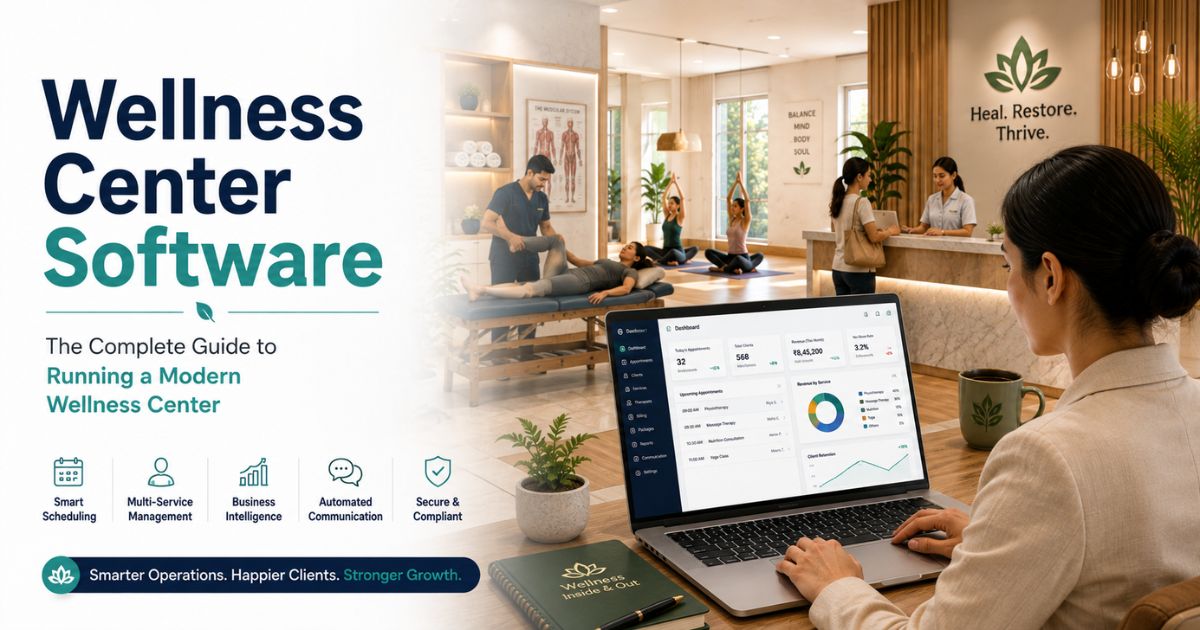
Wellness Center Software: The Complete Guide to Running a Modern Wellness Center
Wellness centers don’t run like a single-service gym. One client books a physiotherapy session. Another wants a massage. A third is there for a nutrition consult. Each service has its own therapist, its own duration, its own price, and its own GST rate. Managing all of that on paper — or across three disconnected apps — is where most wellness centers lose time, revenue, and clients. The right wellness center software brings every service, therapist, and payment into one system, so nothing falls through the cracks.
This guide breaks down what modern wellness centers need from their software, and how an AI Wellness Companion changes the game.
What Makes Wellness Centers Different
A gym sells one thing: access. A wellness center sells many things at once.
- Physiotherapy sessions
- Spa and massage treatments
- Nutrition consultations
- Yoga or movement therapy
- Wellness memberships and treatment packages
Each service needs its own therapist, room, and schedule. That complexity is exactly why generic booking tools fall short for wellness centers.
Types of Wellness Centers
“Wellness center” covers a wide range of businesses, and software needs to flex across all of them:
- Day spas — massage, facials, and body treatments, usually booked in fixed time slots
- Physiotherapy and rehab clinics — session-based care with treatment notes and progress tracking
- Ayurveda and holistic health centers — longer, multi-day treatment programs with therapist continuity
- Nutrition and consultation clinics — recurring check-ins tied to a client’s plan
- Hybrid wellness centers — a combination of two or more of the above under one roof, often paired with yoga or movement classes
- Corporate and hotel wellness facilities — services delivered on behalf of a larger organisation, with its own billing and reporting needs
The common thread across every type is the same: services are booked by appointment, delivered by a specific person, and billed individually. That’s exactly the structure wellness center software is built to handle — regardless of which type of wellness center is running it.
The Real Cost of Running Wellness Centers on Old Tools
Most wellness centers didn’t choose chaos. They grew into it. A paper appointment book works fine with one therapist. It breaks down with five therapists, three service lines, and a hundred repeat clients.
Here’s what that chaos usually looks like:
- Front desk staff calling every client the day before their appointment
- Separate billing spreadsheets for massage, physio, and nutrition
- No shared record of a client’s treatment history
- Therapist double-bookings because no one has a live calendar
- No visibility into which service, or which therapist, actually drives revenue
Each of these costs real money. A missed reminder is a no-show. A no-show is an empty chair-hour. Multiply that across a month, and it adds up fast.
What Wellness Center Software Should Actually Do
Good wellness center software replaces every one of those gaps with a system that runs itself. At minimum, it should handle:
- Multi-service appointment booking — physio, massage, and nutrition, each with its own duration, price, and therapist
- Real-time therapist availability — so clients always land with the right specialist, and no one gets double-booked
- Client health records — intake forms, treatment notes, and progress history, stored securely per client
- Treatment package billing — sell a “10-session physio package” and track usage automatically
- WhatsApp reminders — sent before every appointment, cutting no-shows without a single phone call
- GST-compliant invoicing — with different tax rates applied correctly across services
This is the operational baseline. What separates a good platform from a great one is what happens on top of it: intelligence.
Where AI Changes Wellness Centers
Booking and billing solve yesterday’s problem. AI-powered wellness center software solves tomorrow’s. This is where an AI Wellness Companion earns its place — not as a add-on, but as the layer that tells you what to do next. Throughout the client lifecycle, the AI Wellness Companion supports appointment reminders, personalized follow-ups, package renewal prompts, wellness recommendations, and engagement tracking — helping wellness centers build stronger long-term relationships rather than simply managing bookings.
Predictive Analytics flags clients who are drifting away before they cancel. If someone hasn’t booked in three weeks, the system surfaces it, so a therapist or manager can reach out while there’s still time to save the relationship.
Revenue Intelligence goes beyond a monthly report. Instead of just showing what happened last month, it forecasts revenue for the next 30, 60, and 90 days based on current bookings and trends — and flags which service line is under-performing before it shows up in your bank balance.
An AI Dashboard pulls therapist utilization, service-level revenue, and client retention into one view. No more piecing together numbers from three spreadsheets to answer a simple question: which service is actually making money?
Marketplace Integration connects your wellness center to payment gateways, WhatsApp, and calendar tools you’re likely already using — so switching platforms doesn’t mean switching your entire tech stack.
This is what it means to run on a Wellness Intelligence Platform, not just a booking tool. Traditional software tells you what happened. AI Business Intelligence tells you why it happened, and what to do about it.
The AI Recommendation Engine analyzes each client’s treatment history, goals, and engagement patterns to recommend follow-up services, wellness packages, nutrition consultations, or complementary therapies. Instead of generic promotions, every recommendation becomes relevant to that individual client.
What Changes for a Multi-Service Wellness Center
Picture a wellness center offering physiotherapy, yoga therapy, and nutrition consultations under one roof. Without a unified system, that’s three separate booking calendars, three billing processes, and zero shared client history.
With one intelligent platform:
- A client books any service through a single link — no separate apps
- Every therapist sees only their own schedule, with zero double-bookings
- Billing applies the correct GST rate automatically, per service
- A client’s full treatment history — physio notes, nutrition plans, session count — lives in one profile
- Management sees revenue and utilization across all three services from a single Executive Dashboard, covering therapist utilization, Revenue Intelligence, Wellness Intelligence, membership analytics, client retention, service performance, and branch comparison
That’s the difference between running three businesses that happen to share a building, and running one wellness center that happens to offer three services.
Therapist and Staff Management for Wellness Centers
A wellness center is only as good as its therapists — and therapists are only as productive as their schedule allows. Staff management should cover more than a calendar. It should track:
- Specialisations — so the booking system only offers a client the therapists qualified to treat them
- Availability — set per therapist, per day, so no one gets booked during a break or a day off
- Commission tracking — set a commission rate per therapist or per service, and let the system calculate earnings automatically
- Monthly payout summaries — generated without a manual spreadsheet at month-end
- Performance visibility — utilisation and revenue per therapist, so managers know who’s overbooked and who has open slots
When staff management runs on the same platform as bookings and billing, a therapist’s calendar, client load, and earnings stay in sync automatically. No separate payroll spreadsheet. No end-of-month scramble to calculate commissions by hand.
Wellness Memberships and Client Retention
New clients are expensive to acquire. Returning clients are where wellness centers actually make money. That’s why membership structure matters as much as service quality.
A modern wellness center should be able to offer:
- Monthly unlimited visit plans for clients who want ongoing access
- Class or session packs — a fixed number of visits, used at the client’s own pace
- VIP wellness memberships with added perks or priority booking
- Family plans that bundle multiple members under one billing account
- Auto-renewals and pauses — so a client going on vacation doesn’t have to cancel and re-enroll
Fitzpot’s Relationship Health Score (RHS) measures the strength of each client relationship by combining attendance, booking frequency, engagement, and communication signals. This helps wellness centers identify clients who may be drifting away long before they stop booking altogether.
Predictive Analytics plays a direct role here. Instead of finding out a membership lapsed after the fact, the AI Wellness Companion flags at-risk clients — someone who hasn’t booked in weeks, or whose package is about to expire — early enough for staff to reach out and re-engage them before they’re gone for good.
Running Wellness Centers Across Multiple Locations
Many wellness centers don’t stay single-location for long. A second branch means double the therapists, double the schedules, and — without the right software — double the admin.
A platform built for multi-location wellness centers should offer:
- Centralised client records — so a client can book at any branch, and staff at each location see the same history
- Branch-level reporting — revenue, utilisation, and therapist performance broken out by location
- A single Corporate Dashboard — giving ownership one view across every branch, without logging into separate accounts
- Independent scheduling per branch — each location manages its own therapists and hours, while still rolling up to central reporting
- White-label options — so the client-facing booking experience carries the wellness center’s own brand, not the software vendor’s
The goal isn’t just running two locations. It’s running one wellness business that happens to have two front doors.
Client Experience: Booking Without Friction
Clients don’t want to download an app to book a massage. The best wellness center software removes every unnecessary step between “I want to book” and “I’m booked.”
- Clients receive a booking link via WhatsApp or email and book from any browser — no app download required
- Real-time therapist availability means clients see open slots instantly, instead of waiting for a callback
- Automated confirmations and reminders go out without a front-desk phone call
- Clients can choose in-person, online, or hybrid formats where the service allows it, and each format can be priced differently
Friction at the booking stage is one of the most common — and most fixable — reasons wellness centers lose potential clients before they ever walk in the door.
Data Security and Compliance in Wellness Centers
Wellness centers hold sensitive information: intake forms, treatment notes, health history, progress photos. That data needs protection that goes beyond a locked filing cabinet.
Look for:
- Encryption at rest and in transit for all client health data
- Role-based access, so only the therapist assigned to a client can view their notes
- GDPR compliance, particularly important for wellness centers serving international clients
- Audit-ready records, so ownership can demonstrate data handling practices if ever required
Security isn’t a feature to bolt on later. For a wellness center, it’s part of the trust clients place in the business the moment they fill out an intake form.
Peak-Hour and Seasonal Demand Planning
Wellness centers rarely see steady demand. Evenings and weekends fill up fast; weekday mornings sit empty. Certain services spike around specific seasons — detox and nutrition consultations in January, spa gift packages in December, physio bookings after a local sports season ends.
Utilisation analytics turn that pattern from a guess into a plan:
- Peak booking hours, visible per service and per therapist, so staffing can match demand instead of guessing
- Underbooked slots, flagged early enough to run a targeted promotion and fill them
- Seasonal trend data, feeding directly into the AI Dashboard’s revenue forecasts, so a slow month doesn’t come as a surprise
A wellness center that can see its own demand curve can staff, price, and promote around it — instead of reacting to an empty afternoon after it’s already happened.
Integration Ecosystem for Wellness Centers
A wellness center rarely runs on one tool alone. The strongest software doesn’t try to replace everything — it connects to what’s already in use:
- Payment gateways — accepting UPI, cards, and net banking, with every payment reconciled automatically
- WhatsApp — for confirmations, reminders, and billing alerts, sent without manual follow-up
- Google Calendar — syncing staff schedules so appointments don’t collide with a therapist’s personal calendar
- Zoom — attaching video links automatically for online or hybrid consultations
- Zapier — connecting to thousands of other apps for workflows the core platform doesn’t cover natively
This is the practical meaning of Marketplace Integration: a wellness center keeps the tools its team already knows, while the AI Wellness Companion sits underneath, tying the data together. Marketplace Integration also enables wellness centers to sell wellness packages, supplements, skincare products, memberships, workshops, and online consultations through a single ecosystem — while keeping inventory, payments, and reporting synchronized.
Mobile App for Wellness Center Owners
Wellness center owners aren’t behind a desk all day. A mobile app matters as much as the main dashboard, letting owners and managers:
- Check today’s bookings and therapist schedules from anywhere
- Approve or adjust appointments on the go, without calling the front desk
- Get instant alerts for cancellations, payment issues, or churn-risk clients flagged by the AI Wellness Companion
- Review revenue and utilisation numbers between appointments, not just at the end of the day
For a business built on in-person care, the ability to manage it remotely — even for a few minutes between meetings — is what keeps a wellness center owner from being tied to a single location.
Marketing and Lead Generation for Wellness Centers
Booking software keeps existing clients coming back. But wellness centers still need a steady flow of new ones. The strongest platforms don’t stop at operations — they connect to the channels wellness centers actually use to find clients:
- Instagram and Facebook lead ads — captured directly into the wellness center’s client pipeline, instead of sitting in an inbox
- Campaign recommendations — AI-suggested WhatsApp campaigns based on client segments, visit patterns, and seasonal demand, so promotions go to the right group instead of a blanket blast
- Google Analytics tracking — visibility into website visitors, booking funnel performance, and which ad actually drove a booking
- CRM sync — leads and contacts flowing into a sales pipeline instead of getting lost between a landing page and a front desk notebook
For a wellness center, marketing and operations shouldn’t live in separate systems. A lead that becomes a client should carry their acquisition source, first booking, and full treatment history in one place — not three.
Client Reviews and Reputation Management for Wellness Centers
A wellness center’s reputation is built one appointment at a time — and lost just as easily by a single bad experience left unanswered online. Reviews matter more here than for most businesses, because clients are trusting a wellness center with their body and their health history before they’ve ever met the therapist.
A few practices help wellness centers stay ahead of it:
- Automated post-session follow-ups — a WhatsApp message after an appointment, prompting feedback while the experience is still fresh
- Routing negative feedback internally first — giving the wellness center a chance to resolve an issue before it becomes a public review
- Tracking review trends by therapist or service — so a recurring complaint about wait times or a specific treatment gets caught early
- Turning satisfied repeat clients into referrals — since a wellness center’s best marketing is often a client mentioning it to a friend
Reputation management isn’t a separate task bolted onto the end of a client’s visit. It works best when it’s part of the same automated flow that already sends booking confirmations and reminders.
Retail and Add-On Revenue for Wellness Centers
Appointments aren’t the only revenue line for a wellness center. Supplements, skincare, wellness accessories, and take-home products add a second income stream — if the point-of-sale system can keep up.
A wellness center benefits from retail POS that can:
- Sell products alongside services at checkout, in the same transaction
- Track inventory in real time, so popular items don’t run out unnoticed
- Report retail revenue separately from service revenue, for a clear picture of what’s actually driving growth
- Apply the correct GST rate on products, distinct from the rate applied to services
Retail add-ons are often the easiest revenue a wellness center leaves on the table — mainly because the checkout process was never built to sell anything beyond the appointment itself.
Corporate Wellness Partnerships: A New Revenue Stream
Individual clients aren’t the only source of business for a wellness center. Companies increasingly buy wellness services in bulk for their employees — on-site massage days, discounted physiotherapy packages, or nutrition consultation credits offered as a workplace benefit.
For a wellness center, servicing a corporate client well requires a few things a consumer-facing booking flow doesn’t:
- Bulk package billing — invoicing one company for many employees’ sessions, instead of billing each person individually
- Usage reporting — showing the corporate client how many of their allotted sessions employees actually used
- A separate booking flow for corporate clients, so employee bookings don’t get mixed into the general client list
- Flexible scheduling — since corporate bookings often cluster around lunch hours or specific weekdays
A wellness center that can offer this cleanly opens up a revenue stream that’s more predictable than walk-in traffic — a handful of corporate accounts can fill a meaningful share of otherwise slow weekday hours.
Migration: Switching Software Without Losing Data
The biggest reason wellness centers delay switching software isn’t cost. It’s fear of losing years of client history in the move. A proper migration path removes that risk entirely, and typically follows three steps:
- Set up the business profile — services, pricing, therapists, and branding, guided by a setup wizard (roughly 15 minutes)
- Import existing data — client records, appointment history, and packages migrated over, free of charge, from whatever system the wellness center was using before (roughly 30 minutes)
- Launch — go live the same day, with AI insights starting to build from day one
A wellness center that switches software shouldn’t have to start its client relationships from scratch. Migration support exists specifically so history isn’t the cost of upgrading.
Getting Your Team Onboard With New Software
The best wellness center software still fails if the front desk and therapists don’t actually use it. Adoption usually goes smoother when a wellness center handles the rollout in stages rather than all at once:
- Start with the front desk — booking and payments are the most visible daily change, so getting that team comfortable first builds confidence for the rest of the rollout
- Bring therapists in next — showing them how their own schedule, client notes, and commission tracking work removes the “extra admin work” objection early
- Keep the old system running in parallel for a short window — a brief overlap reduces the fear of losing a booking during the switch
- Assign one internal point of contact — someone who becomes the go-to for questions, instead of every staff member hunting for help separately
A wellness center’s team doesn’t need to master every feature on day one. They need enough confidence in the basics — booking, checking a schedule, taking a payment — to trust that the new system won’t slow them down.
What Wellness Centers Typically Gain From Switching
Results vary by business size and starting point, but wellness centers that move from spreadsheets and paper booking to a unified platform often report:
- Fewer no-shows, thanks to automated WhatsApp reminders replacing manual phone calls
- Higher renewal rates, as expiring memberships and packages get flagged before they lapse
- Meaningful time savings at the front desk, since booking, reminders, and billing no longer require separate manual steps
- Clearer visibility into which services and therapists actually drive revenue, instead of guessing from memory
These aren’t guaranteed outcomes — they depend on how consistently a wellness center uses the automation available to it. But the direction is consistent: less admin, more retention.
A Wellness Center Case Study
Serenity Wellness Center in Kochi runs physiotherapy, yoga, and nutrition consultations under one roof — exactly the multi-service structure this guide has been describing. According to the center’s own reporting after adopting a unified platform, they saw a patient satisfaction score of 92, a 35% gain in staff efficiency, and appointment utilisation reaching 94%.
Figures like these come from one center’s self-reported results, not an independent audit, so they’re best read as a sense of what’s possible rather than a guarantee. What they do illustrate clearly: a wellness center offering multiple services can run all of them — booking, billing, and staff scheduling — through one system, without splitting operations by service line.
What Does Wellness Center Software Cost?
Pricing for wellness center software usually scales with the size of the business — number of therapists, number of locations, and which features are included. A few things are worth checking before comparing quotes:
- Whether setup and onboarding are free, or billed as a separate one-time cost
- Whether WhatsApp automation and AI insights are included, or sold as add-ons on top of the base plan
- Whether pricing changes with client volume, or stays flat regardless of how many bookings come through
- Whether there’s a free trial period long enough to actually test the booking flow with real clients, not just a demo account
The honest way to evaluate cost isn’t the monthly fee in isolation — it’s the fee weighed against what a wellness center currently loses to no-shows, admin hours, and lapsed memberships it never caught in time. For most wellness centers, that comparison is what actually decides whether switching pays for itself.
Choosing Wellness Center Software: What to Look For
Before committing to a platform, wellness centers should check for:
- Multi-service configuration — can it handle different pricing, duration, and GST per service?
- Therapist-level scheduling — does it prevent double-bookings automatically?
- Client health record storage — is data encrypted, and access role-based?
- Automated communication — does it send reminders without manual follow-up?
- AI-driven insights — does it predict churn and forecast revenue, or just report history?
- Migration support — can existing client data move over without starting from zero?
A wellness center that gets these six right spends less time on admin — and more time on client care.
Frequently Asked Questions: Wellness Center Software
Can wellness center software handle multiple services like physio, yoga, and nutrition under one system?
Yes. Each service type can be configured with its own pricing, duration, therapist, and GST rate, while clients see and book all services from one place.
Do clients need to download an app to book an appointment?
No. Clients can receive a booking link over WhatsApp or email and book directly from a browser.
Is client health data stored securely?
Client health information — intake forms, treatment notes, and progress history — should be encrypted at rest and in transit, with role-based access limiting visibility to authorized staff only.
Can wellness centers manage therapist commissions through the same platform?
Yes. Commission rates can be set per therapist or per service, with earnings and payout summaries calculated automatically each month.
Does wellness center software support multiple locations?
Yes, for centers that operate more than one branch. Each location manages its own therapists and schedules, while ownership sees consolidated reporting across all branches.
What about insurance billing for physiotherapy clients?
Direct billing and detailed invoicing are standard. Insurance reimbursement workflows typically require a separate integration with the provider’s system.
The Bottom Line
Wellness centers succeed on trust and consistency: the right therapist, on time, every time. Software shouldn’t complicate that — it should protect it. A platform built around an AI Wellness Companion turns appointment books, billing spreadsheets, and therapist rosters into one intelligent platform that runs quietly in the background, so the team can focus on care instead of admin.
That’s the shift happening across wellness centers today: from managing chaos, to running a business that understands itself.