
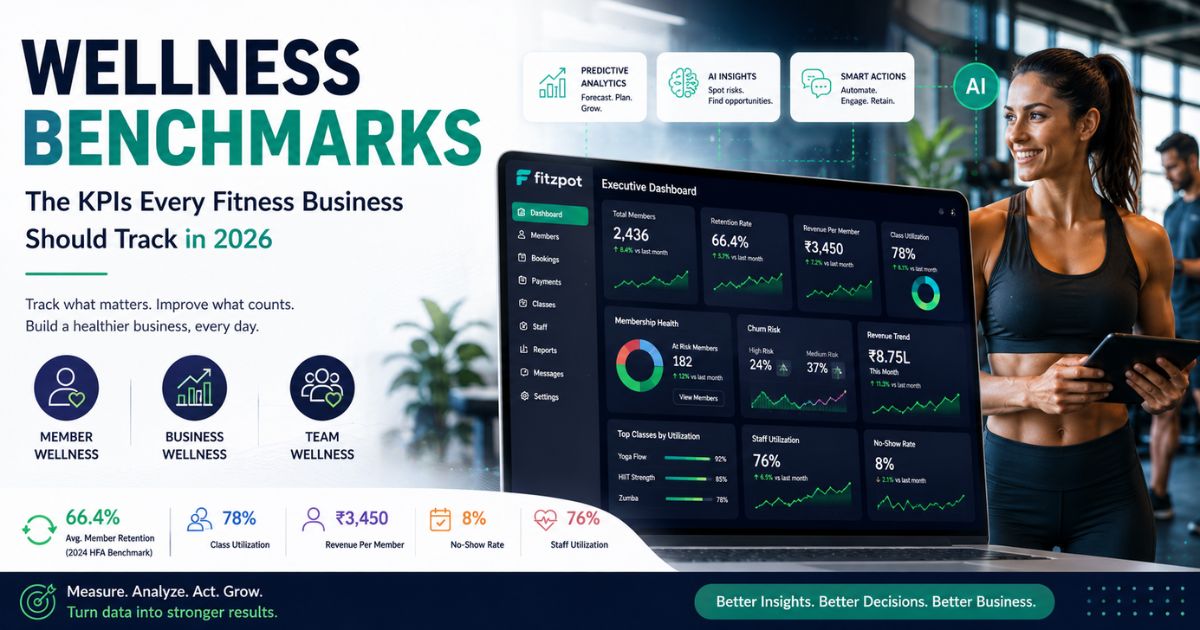
How AI Turns Wellness Benchmarks 2026 Into Business Intelligence
Wellness benchmarks 2026 tell you if your fitness or wellness business is truly healthy. Not "busy." Not "feels fine." Just healthy. You can measure it. You can compare it. You can improve it.
Most gym, studio, and wellness center owners track revenue. Fewer track wellness benchmarks 2026. But these benchmarks predict where revenue is headed next. This gap causes real problems. Members quietly leave. Classes quietly go empty. Staff quietly burn out. All this happens before it shows up on a P&L statement.
This guide covers the core wellness benchmarks to track. It shows how they differ across business types. It also shows how an AI-powered platform turns raw numbers into action.
What Are Wellness Benchmarks?
Wellness benchmarks are standard metrics. They measure the health of a fitness or wellness business. They cover three areas:
· Member wellness — attendance, engagement, progress toward goals
· Business wellness — retention, revenue per member, utilization
· Team wellness — staff workload, burnout risk, performance
A benchmark only becomes useful when you compare it. Compare it against last month. Against last year. Against your industry.
Why Universal Benchmarks Can Mislead You
Industry-wide numbers exist. The Health & Fitness Association's 2025 Benchmarking Report found an average retention rate of 66.4% for 2024. This came from participating fitness businesses. Numbers like this are a good starting point.
But they are not a target. Retention, attendance, and revenue benchmarks vary. They depend on business type, location, and pricing. A boutique yoga studio and a 24-hour gym will never share the same "normal."
Treat industry benchmarks as context. Treat your own historical data as the real target.
Core Wellness Benchmarks Every Business Should Track
1. Member Retention Rate
This is the percent of members who stay active over time. Retention is a key sign of long-term business health. Why? Members who stay bring steady, recurring revenue. They also add more lifetime value.
2. Attendance Frequency
This tracks how often each member shows up. A steady drop in attendance is a warning sign. It often means engagement is falling. It can lead to churn.
3. Churn Rate
This is the percent of members who cancel or lapse. Pair it with retention rate. Together, they give you the full picture.
4. Revenue Per Member (RPM)
Divide total revenue by active members. This is RPM. It shows where growth comes from. Is it new members? Or existing members spending more?
5. Class and Slot Utilization
This is the percent of class spots, courts, or appointments actually booked. Low utilization is a warning sign. It often points to a scheduling problem. It's not always a marketing problem.
6. Net Promoter Score (NPS)
This is a simple score. It asks: "How likely are you to recommend us?" It's a quick read on member satisfaction. You get it between renewal cycles.
7. Staff Workload and Utilization
This tracks sessions, classes, or clients per staff member. Track it alongside client outcomes. This helps you catch burnout early. It protects your service quality.
Results vary by business type and market. Use these as tracking categories. They are not fixed targets.
How AI Turns Wellness Benchmarks Into Business Intelligence
Tracking a number in a spreadsheet tells you what already happened. That's reporting. Modern Business Intelligence goes further by connecting data across the business, surfacing patterns and helping decision-makers understand what is driving performance. Combined with predictive analytics, it can also help anticipate what may happen next.
This is where an AI-powered Wellness Intelligence Platform changes the equation:
· Predictive Analytics forecasts attendance, revenue, and churn risk. You see problems before they hit your monthly report.
· AI Recommendation Engine looks at each client's history, goals, and engagement. It recommends the right follow-up service or package. No generic promotions.
· Relationship Health Score (RHS) combines attendance, bookings, engagement, and communication into one score. It flags members who are drifting away. This happens before they stop booking.
· Individual Wellness Score tracks a single member's progress against their own goals over time.
· Corporate Wellness Score rolls up individual scores. It creates one facility-wide or company-wide benchmark. This is useful for corporate wellness partnerships.
· Burnout Risk Monitoring applies this same logic to staff. It flags overloaded trainers and therapists early. This happens before performance or retention suffers.
An AI Wellness Companion puts these benchmarks to work automatically. It sends appointment reminders. It sends personalized follow-ups and renewal prompts. It sends wellness recommendations tied to each client's stage.
Wellness Benchmarks Across Business Models
Wellness benchmarks shift depending on what you run:
· Gyms — retention rate, class utilization, revenue per member
· Yoga and dance studios — class pack renewal rate, waitlist conversion, instructor utilization
· Personal trainers — package renewal rate, session attendance, client progress milestones
· Wellness centers and physio clinics — treatment completion rate, therapist utilization, repeat booking rate
· Multi-location chains — branch-level P&L, cross-branch retention comparison, centralized staff utilization
One unified system can track these benchmarks. It works across every service line. This is what makes comparison possible.
What a Modern Unified Wellness Intelligence Platform Looks Like
Many fitness businesses still track operational metrics across multiple disconnected tools — a spreadsheet for attendance, a separate app for payments, WhatsApp for reminders, and a POS for retail.
A unified platform brings these benchmarks into one Executive Dashboard. It covers therapist and trainer utilization. It covers Revenue Intelligence and Wellness Intelligence. It covers membership analytics, client retention, and service performance. You also get branch-by-branch comparison. All in one view.
Marketplace Integration takes this further. It lets you sell wellness packages, supplements, and memberships. It also covers workshops and online consultations. Inventory, payments, and reporting all stay in sync.
The goal isn't just another dashboard. It's one intelligent platform. Every wellness benchmark lives in the same place — member, business, and staff. It updates in real time. It feeds AI recommendations back into daily work.
How to Start Benchmarking Your Wellness Business
1. Pick 4–5 core benchmarks from the list above. Don't try to track everything at once.
2. Build your own baseline first. Track for 60–90 days before comparing to industry numbers.
3. Review benchmarks monthly, not just at renewal time.
4. Automate tracking wherever you can. Benchmarks should update in real time. Don't wait for a manual month-end review.
5. Use AI-driven alerts. Churn risk and burnout risk flags work well. Act on a benchmark before it becomes a problem.
Bottom line
Wellness benchmarks only create value when something watches them. That watcher can be you, or it can be AI. An AI Business Intelligence platform watches automatically. It turns scattered numbers into one clear, trustworthy picture of business health.