
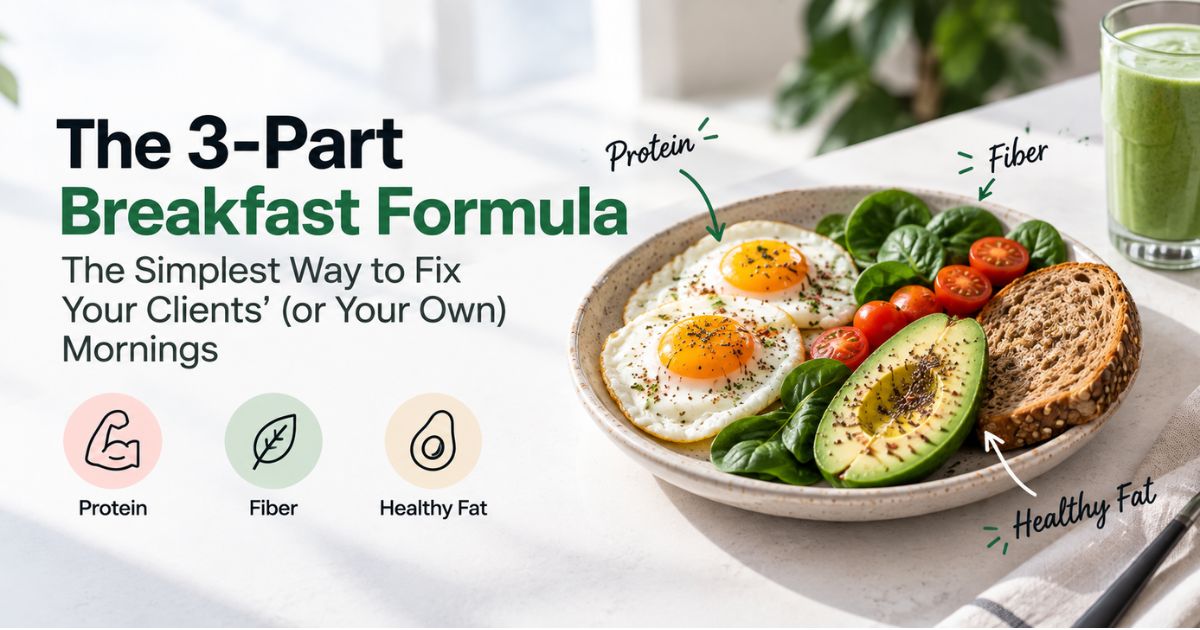
The 3-Part Breakfast Formula: The Simplest Way to Fix Your Clients' (or Your Own) Mornings
Ask ten gym members what they had for breakfast and you'll get ten different answers — a protein shake, black coffee, leftover pizza, or nothing at all. The inconsistency isn't a willpower problem. It's a 3-part breakfast formula problem. Most people have never been given a simple formula for building a balanced, satisfying breakfast that supports their energy and daily nutrition.
The 3-Part Breakfast Formula is a simple way to build a more balanced breakfast: include a good protein source, a fiber-rich food, and a source of healthy fat when appropriate. It isn't a diet or a rigid meal plan — it's a practical checklist that can help clients build more satisfying meals.
What Is the 3-Part Breakfast Formula?
The formula is built on three pillars that, together, support two things that can make a breakfast more satisfying: steadier energy and satiety (how full you feel, and for how long).
- Protein — builds and preserves muscle, and is one of the most useful nutrients for supporting satiety and helping clients meet their daily protein needs
- Fiber — supports digestive health, contributes to fullness, and can slow the absorption of carbohydrate-rich foods
- Healthy fat — extends satiety further and helps absorb fat-soluble vitamins
Each component serves a different role. Protein can support satiety and muscle maintenance, fiber contributes to digestive health and can slow the absorption of carbohydrate-rich foods, and dietary fat can contribute to satiety while helping the body absorb fat-soluble vitamins. The ideal balance varies from person to person.
Part 1: Protein — The Non-Negotiable
A practical target: for many active adults, getting roughly 20–30 grams of protein at breakfast can be a useful starting point. Individual needs vary based on body size, age, activity level and total daily protein intake.
Easy sources:
- Eggs or egg whites (3 whole eggs ≈ 18g; add 2 whites for 25g+)
- Greek yogurt or skyr (150–200g ≈ 20–24g)
- Cottage paneer or paneer bhurji
- Protein powder blended into oats or a smoothie
- Sprouts, moong dal chilla, or besan omelette for plant-based clients
Part 2: Fiber — The Fullness & Digestion Support
Fiber can make a breakfast more satisfying while also supporting digestive health. Fiber-rich foods can slow digestion and, depending on the food and meal composition, may contribute to a more gradual rise in blood glucose and greater fullness.
Easy sources:
- Berries, apple, or papaya (whole fruit, not juice)
- Oats or dalia (steel-cut over instant where possible)
- Chia or flax seeds stirred into yogurt
- Vegetables folded into an omelette or upma
- A handful of soaked almonds or a small serving of whole-grain toast
Part 3: Healthy Fat — The Satiety Extender
Dietary fat can contribute to satiety and is important for absorption of fat-soluble vitamins. Including foods such as nuts, seeds, avocado or whole eggs can also add flavor and nutritional variety.
Easy sources:
- Avocado (half, on toast or in a bowl)
- Nuts or nut butter (a thumb-sized portion)
- Ghee or olive oil used in cooking
- Whole eggs instead of whites-only
- Seeds — chia, flax, pumpkin
Why This Matters for Retention, Not Just Nutrition
For gym owners, personal trainers, and nutritionists, breakfast is one simple nutrition habit you can help clients structure, for one simple reason: it happens before your client ever sees you.
For some clients, establishing a consistent breakfast routine can make it easier to manage hunger, energy and overall meal structure around training. This may also help some clients:
- Manage hunger later in the day
- Avoid feeling discouraged when hunger makes their nutrition plan harder to follow
- Blame "no willpower" for what may simply be a meal that wasn't sufficiently satisfying
This is exactly the kind of bite-sized, repeatable guidance that turns a one-time consultation into an ongoing relationship. A single WhatsApp message with the formula and a photo of a sample plate can be easier for a client to use than a long PDF they may never revisit.
If you're a nutritionist or personal trainer using a platform like Fitzpot, this kind of tip fits naturally into automated client check-ins — send it as a scheduled WhatsApp nudge the morning after a session, or attach it to a renewal reminder as a value-add. Small, consistent touchpoints like this are often what separates a client who renews from one who quietly disappears after month two.
Common Mistakes to Avoid
- Relying on juice for fiber. Whole fruit generally provides more fiber and physical volume than fruit juice, so choose whole fruit when you want those benefits.
- Treating cereal as a complete meal without checking the label. Some cereals are relatively low in protein and fiber, so consider pairing them with yogurt, milk, nuts, seeds or fruit.
- Skipping breakfast isn't automatically a problem. Some people prefer eating later and can maintain a balanced diet without breakfast. For clients who become excessively hungry or struggle with energy and training performance when they skip it, a balanced breakfast may be a useful strategy.
- Over-relying on protein bars. Convenient, but many are closer to a candy bar with a protein claim — check the fiber and sugar line, not just the protein number.
Conclusion
Breakfast doesn't need a meal plan, a macro app, or a strict recipe to work in a client's favor — it needs a formula simple enough to survive a rushed morning. Protein for satiety, fiber for digestive health and a more balanced carbohydrate response, and healthy fat for satiety and nutrient absorption — that's the basic framework. Teach it once, and clients can apply it to almost any dish in their own kitchen, whether that's an omelette, a smoothie, or dal and curd.
For gym owners, trainers, and nutritionists, the real win isn't the nutrition tip itself — it's the consistency it creates. For some clients, establishing a consistent breakfast routine can make it easier to manage hunger, energy and overall meal structure around training, which can support sticking to a plan more easily and staying engaged between check-ins. Small, repeatable habits like this compound into the kind of long-term adherence that keeps members renewing month after month.