
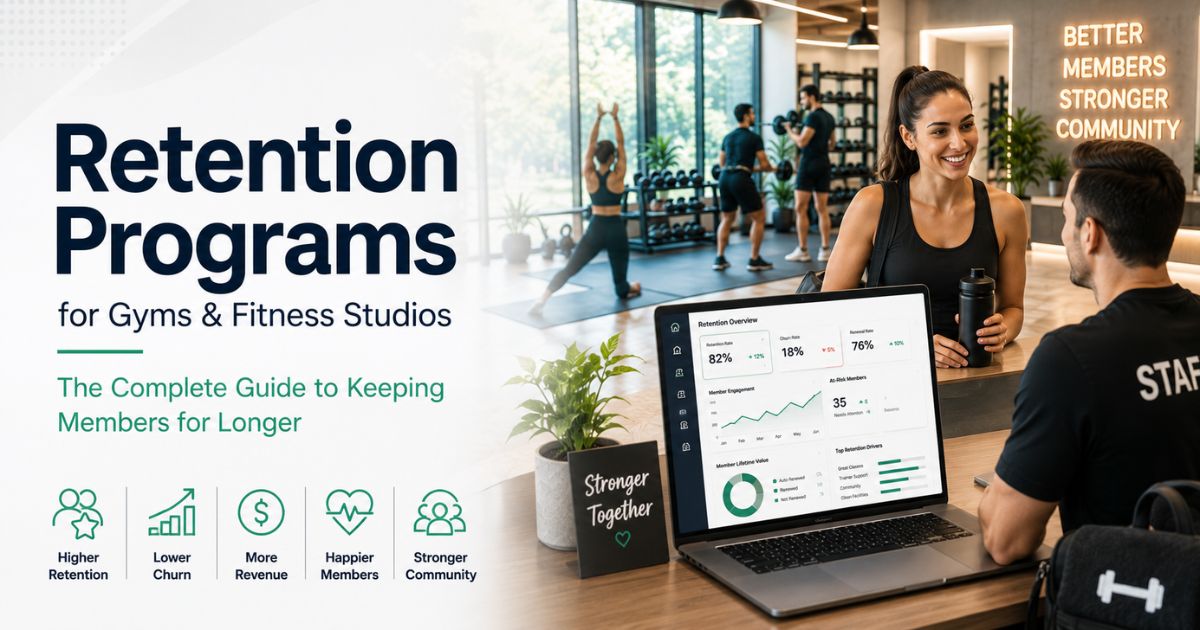
Retention Programs for Gyms & Fitness Studios: The Complete Guide to Keeping Members for Longer
Every fitness business owner knows this: it costs five to seven times more to get a new member than to keep one you already have. That’s why retention programs for gyms are so critical — yet most gyms and studios still spend most of their marketing budget on new sign-ups. Meanwhile, members quietly leave — unnoticed, until the monthly revenue report tells the story nobody wants to read.
A retention program flips that. Instead of treating member churn as a cost of doing business, a real retention program treats it as a problem you can solve. It gives you clear levers to pull before a member ever cancels.
This guide breaks down what retention programs are, why they matter more than acquisition in 2026, and how to build one for your gym, studio, or wellness business.
What Is a Retention Program?
A retention program is a deliberate, repeatable system — not a one-off promotion. It's designed to keep existing members engaged, satisfied, and paying month after month. It usually combines:
• Early warning signals — attendance drop-offs, expiring memberships, missed payments
• Proactive communication — check-ins, renewal reminders, win-back campaigns
• Reward mechanics — loyalty perks, referral incentives, milestone recognition
• Data and feedback loops — surveys, NPS scores, churn analysis
The key word is program. A birthday email here and a discount there isn't a retention strategy — it's just a reaction. A real program runs continuously in the background, whether or not your front desk remembers to send that follow-up text.
Why Retention Matters More Than Ever
The fitness industry has a well-known churn problem. Average gyms lose 30–50% of their members every year, according to industry benchmarks. Boutique studios often see even higher drop-off in the first 90 days. A few realities make retention the highest-leverage area for fitness business owners right now:
• Acquisition costs keep rising. Paid ads on Meta and Google get more expensive every year, while organic reach keeps shrinking
• Members have more choices. Between big-box gyms, boutique studios, home fitness apps, and YouTube content, loyalty is harder to earn and easier to lose
• The first 90 days decide everything. Most cancellations happen in the first three months — before a member builds the habit that keeps them coming back
• Retained members spend more. Loyal members are more likely to buy retail products, upgrade packages, and refer friends — adding value beyond the monthly fee
In short: a 5% improvement in retention can raise profitability by 25–95%, according to widely cited research. Few other moves in a fitness business offer that kind of return.
The 5 Pillars of an Effective Retention Program
1. Onboarding That Builds Habit, Not Just Paperwork
Retention starts before a member's first workout. A structured onboarding sequence cuts early churn — a welcome message, a goal-setting talk, a first-week check-in, and a clear next step. Members who finish structured onboarding in their first two weeks are far more likely to still be active six months later.
Action step: Map out a 30-day onboarding journey with at least three touchpoints — day 1, day 7, and day 21. Trigger each one automatically instead of relying on memory.
2. Predictive Churn Detection
The biggest shift in retention strategy in recent years is this: moving from reactive to predictive. Instead of waiting for a member to cancel, modern gyms use attendance patterns, payment history, and engagement data to flag at-risk members weeks in advance.
Common early-warning signals include:
• No visits in 10–14 days, for a previously regular member
• A renewal date within the next 3–5 days with no confirmation
• A sudden drop in class bookings
• A missed or failed payment
This is where AI-powered platforms change the game. They flag a member as "at risk" 30 days before they'd otherwise cancel. That gives staff time to send a personal message instead of a generic renewal notice sent too late.
3. Proactive, Personal Communication (at Scale)
Personal outreach works. A phone call or a genuine "we noticed you've been away" message converts far better than a mass email. The problem has always been scale — a front-desk team can't personally track hundreds of members' attendance.
This is where automation earns its keep. WhatsApp is now the default channel for millions of fitness consumers in India, the UAE, and the UK. It has much higher open rates than email. Automated but personalized WhatsApp check-ins, renewal reminders, and win-back messages let a small team run outreach that would otherwise need several extra staff.
Action step: Automate renewal reminders at 7 days, 3 days, and 1 day before expiry. Trigger a personal check-in the moment attendance drops below your threshold — don't wait for the cancellation request.
4. Loyalty, Recognition & Community
People stay where they feel seen. Simple recognition beats discounts when it comes to long-term retention:
• Milestone shout-outs — 50th class, 1-year anniversary
• Referral rewards that turn happy members into your best acquisition channel
• Small-group challenges or leaderboards that build peer accountability
• Instructors and staff who know members by name — backed by a system, not memory
Community multiplies retention. Members with even one workout buddy are far less likely to cancel than members who train alone.
5. Feedback Loops That Catch Problems Early
Every cancellation is a lagging indicator. By the time someone cancels, the real reason — a bad class experience, a billing frustration, an unresolved complaint — happened weeks earlier. Regular, lightweight feedback catches this early: a quick post-class rating, a quarterly satisfaction check, or an exit survey for members who leave. It turns invisible frustration into a signal you can act on.
Building Your Retention Program: A Practical Framework
The businesses that get the best results treat this as a system, not a campaign. It runs quietly in the background of daily operations, powered by the same data that drives billing, scheduling, and attendance.
Common Retention Mistakes to Avoid
• Treating retention as a marketing task instead of an operational one. Retention is built into attendance tracking, billing, and scheduling — not just email campaigns
• Waiting until the renewal date to act. By then, a disengaged member has often already checked out mentally
• Relying on manual tracking. Spreadsheets don't scale. Busy front-desk staff will always help the member standing in front of them over the one who hasn't shown up in two weeks
• Discounting instead of engaging. A discount might delay a cancellation by a month. Genuine engagement prevents it altogether
How Technology Makes Retention Programs Actually Work
These strategies aren't new. Good gym owners have always known a personal check-in beats a generic email. What's changed is the ability to run these strategies at scale, without hiring a full-time retention team.
Modern fitness management platforms combine attendance data, payment history, and booking patterns. They automatically flag at-risk members and trigger the right message through the right channel — often WhatsApp — before a cancellation happens. Features like AI-driven churn prediction, automated renewal reminders, and campaign recommendations based on member segments mean a two-person front desk can run a program that used to need a dedicated CRM team.
If you're tracking renewals in a spreadsheet and sending reminders by hand, the fastest way to improve retention isn't a new discount or loyalty card. It's closing the gap between "a member is at risk" and "someone reaches out" — and doing it automatically, every time.
Final Thoughts
A retention program isn't a single tactic. It's the compounding effect of good onboarding, early risk detection, consistent personal communication, and a genuine sense of community — all running reliably in the background of your business. Gyms and studios that build this as a system, rather than reacting member-by-member, consistently see higher renewal rates, lower no-show rates, and members who stay for years instead of months.
The businesses winning in 2026 aren't necessarily the ones with the flashiest acquisition campaigns. They're the ones that never let a member quietly disappear in the first place.