
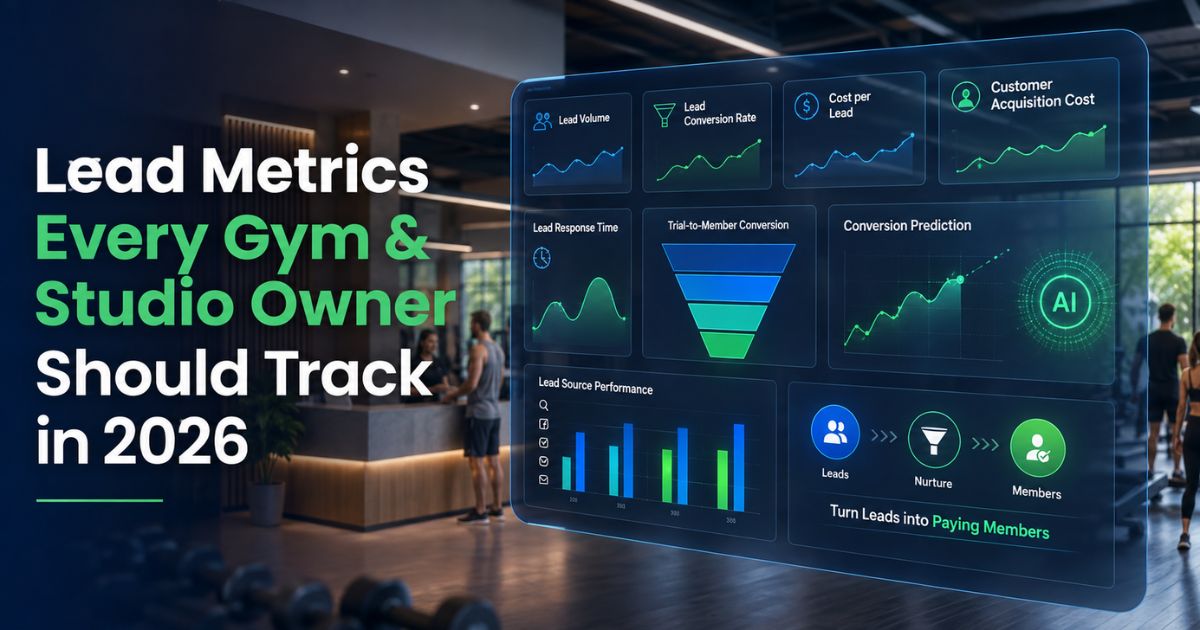
Lead Metrics Every Gym & Studio Owner Should Track in 2026
Gym Lead Metrics Every Owner Should Track in 2026
More leads feel like progress. A full inbox of trial sign-ups, a busy front desk, a phone that won’t stop buzzing — it looks like growth. But volume alone doesn’t pay the bills. What pays the bills is conversion, and you can’t improve what you don’t measure. That’s where gym lead metrics come in. They tell you, in hard numbers, whether your marketing spend, your front-desk follow-up, and your sales process are actually turning strangers into members — or quietly leaking revenue every single day.
This guide breaks down the lead metrics that matter most for gyms, studios, and wellness businesses, how to calculate each one, and what “good” actually looks like.
What Counts as a Lead, exactly?
Before you can track lead metrics, you need a clear definition of a lead in your business. Otherwise your numbers won't mean anything.
A lead is typically anyone who takes a specific, trackable action showing interest — not just someone who “liked” a post. Common lead-triggering actions include:
• Booking a free trial class or day pass
• Filling out a “request pricing” or contact form
• Messaging your business on Instagram, WhatsApp, or your website chat
• Walking in and asking about membership
• Being referred by an existing member
Write this definition down and make sure your whole team — sales, front desk, marketing — uses the same one. Inconsistent definitions are one of the most common reasons lead metrics end up unreliable.
The Core Lead Metrics to Track
1. Lead Volume by Source
Simply: how many leads came in, and from where (Instagram ads, Google, referrals, walk-ins, WhatsApp, events)?
This is your starting point, but volume alone is a vanity metric. A source generating 200 leads a month that never convert is worse than a source generating 20 leads that mostly join. Track volume alongside conversion rate for each channel, not in isolation.
2. Cost Per Lead (CPL)
Formula: Total marketing spend ÷ Number of leads generated
If you spent ₹20,000 on Instagram ads and got 50 leads, your CPL is ₹400. Track this per channel so you know where your money is working hardest. CPL on its own can be misleading, though — a cheap lead that never converts is more expensive than an expensive one that becomes a long-term member. Always pair CPL with conversion rate and customer acquisition cost (below).
3. Customer Acquisition Cost (CAC)
Formula: Total sales + marketing costs ÷ New paying members acquired
This is the number that actually matters for your budget. Unlike CPL, it accounts for both marketing spend and the sales effort behind closing a member — giving you the true, fully-loaded cost of one new paying member from a given channel, not just one inquiry.
4. Lead Response Time
Formula: Time between a lead coming in and your first response
This is one of the most predictive metrics in the entire funnel. Lead response time is a critical operational metric. In general, faster responses give businesses a better opportunity to engage prospects while their interest is still high.
If you're relying on staff to manually check a shared inbox or spreadsheet, this number tends to quietly drift upward without anyone noticing. Automated communication through WhatsApp, SMS, or email can help reduce the delay between inquiry and first contact, including outside business hours.
5. Lead-to-Trial Conversion Rate
Formula: (Leads who booked a trial ÷ Total leads) × 100
This shows how well your first response and follow-up sequence move someone from “curious” to “showed up.”
6. Trial-to-Member Conversion Rate
Formula: (Trials who became paying members ÷ Total trials) × 100
This is the number most gym owners care about most, because it reflects your in-person sales process — the tour, the consultation, the offer. What counts as a strong conversion rate varies by niche, price point, and market, so it's most useful tracked as a trend against your own historical performance rather than compared to a fixed industry benchmark.
7. Lead-to-Member Conversion Rate (Overall)
Formula: (New members ÷ Total leads) × 100
This is your end-to-end health check — the number that tells you, across the whole funnel, what percentage of interest turns into revenue. Track it monthly and watch the trend line more than any single month's number.
8. Follow-Up Consistency Rate
Formula: (Leads who received at least two follow-up touchpoints ÷ Total leads) × 100
Many “lost” leads aren't lost because they said no — a significant share are lost simply because nobody followed up a second or third time. If this number is low, you likely have a process gap, not a marketing gap.
9. Lead Source Quality (Conversion Rate by Channel)
Break every metric above down by channel. A referral lead, a Google Ads lead, and an Instagram DM lead behave very differently.
Referral leads can behave differently from paid leads because they often arrive with some existing trust. Tracking conversion by source shows whether that advantage exists in your own business.
AI Lead Scoring & Conversion Prediction
Tracking the metrics above tells you what already happened. The next step is knowing, right now, which of today's leads are actually worth calling first.
Fitzpot's AI roadmap includes Lead Conversion Prediction, which can score leads by their likelihood of converting, using historical and behavioral signals to estimate conversion probability.
This can help teams prioritize higher-probability leads instead of relying entirely on manual judgment. A high-intent lead from a lower-volume channel gets called before a low-intent lead from a high-volume one — which means less time spent chasing inquiries that were never going to convert, and faster follow-up on the leads most likely to become paying members.
This turns lead scoring from a manual judgment call — usually based on whoever's gut feeling is loudest in the room — into a consistent, data-backed prioritization every staff member can follow the same way.
Building a Simple Lead Metrics Dashboard
A spreadsheet works for a single small studio. But once you're running multiple channels, multiple staff members, and more than a handful of leads a week, manual tracking breaks down fast — leads get missed, follow-ups slip, and your numbers stop reflecting reality.
This is exactly the gap purpose-built fitness management software is designed to close. Fitzpot connects customer, membership, booking, payment and marketing data in one platform, while tracking where members come from. Its dashboards provide real-time visibility into revenue, member performance, retention, classes and staff performance, while its AI capabilities surface predictive insights on top. For lead conversion prediction specifically, Fitzpot's roadmap includes AI-powered scoring to help businesses identify higher-probability opportunities.
Common Mistakes That Skew Lead Metrics
• Tracking leads, not outcomes — counting form fills without following each one through to member or no is just counting noise.
• No standard definition of a lead — if sales and marketing define “lead” differently, your reports won't agree with each other.
• Ignoring response time — it's one of the metrics most correlated with conversion, and one of the easiest to fix.
• Comparing channels on volume alone — the cheapest lead source isn't always the most profitable one.
• Reviewing metrics quarterly instead of monthly — fitness marketing shifts fast, and a channel that worked in January may be underperforming by March.
The Bottom Line
Lead metrics turn “we're getting a lot of interest” into an actual growth strategy. Track cost per lead alongside customer acquisition cost. Watch response time like a hawk. And always follow the funnel through to the number that actually matters — how many leads become paying, long-term members.
The gyms and studios that grow predictably aren't the ones with the most leads. They're the ones who know exactly what happens to every single one.
Want to see your lead-to-member conversion rate — and which leads to call first — on one dashboard instead of piecing it together from three tools? Start a free 14-day Fitzpot trial — no credit card required.