
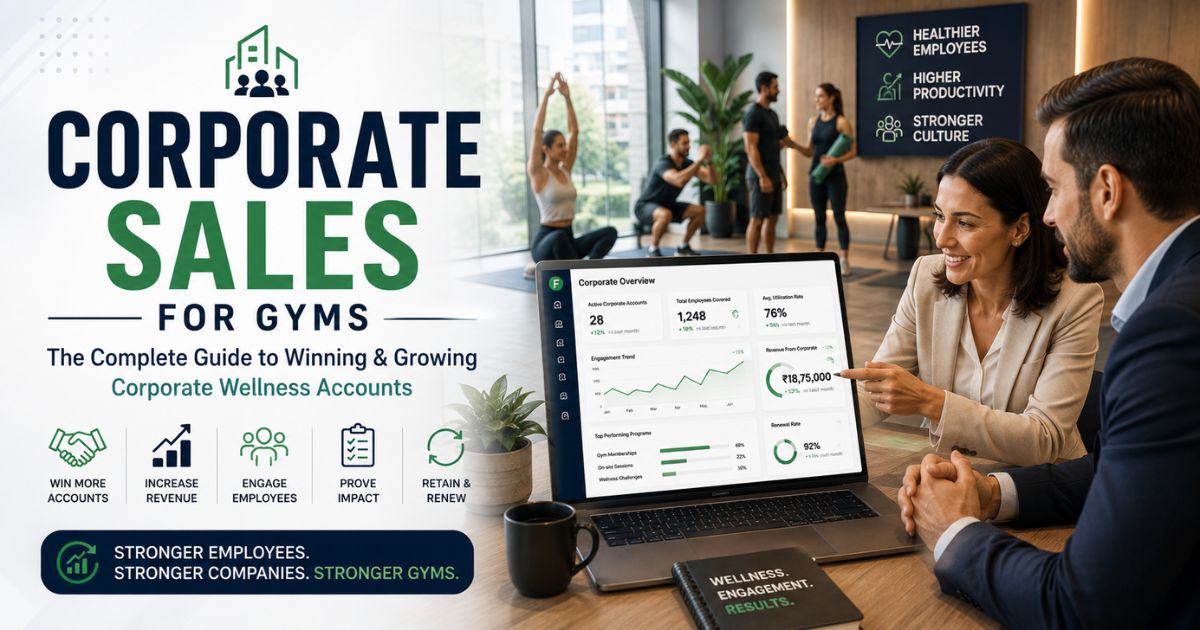
Corporate Sales for Gyms and Fitness Studios: The Complete Guide
One corporate account can be worth more than fifty single sign-ups. In fact, corporate sales for gyms are often easier to close, too. One HR manager says yes, and suddenly forty employees walk through your door — with their membership already paid for by someone else. Yet most gyms and studios still treat corporate sales as an afterthought. A flyer gets left at a nearby office park. A discount code gets handed out once and never followed up on.
Corporate sales is one of the most overlooked ways to grow a fitness business. It looks unfamiliar, so many owners skip it. Gym owners know how to sell to a walk-in. Selling to a company is different — it goes through procurement, HR, and a yearly budget cycle. But it's a skill you can learn, and the payoff is steady, high-volume revenue that doesn't depend on this month's Instagram ad spend.
This guide covers what corporate fitness sales really involves: who the real buyer is, how to build an offer companies say yes to, what a winning pitch looks like, common deal structures, and how to manage and renew accounts once you've signed them.
What Does "Corporate Sales" Mean for a Fitness Business?
Corporate sales means selling memberships, wellness programs, or fitness services to a company for its employees. You're not selling to one person at a time. Instead, a whole organization signs a contract, and your gym gets a batch of new members — or a recurring wellness partnership — in a single deal.
This usually takes one of a few forms:
• Corporate memberships — employees of a partner company get discounted or subsidized access to your gym
• On-site or on-demand wellness sessions — trainers or yoga instructors visit an office, or run virtual sessions, as part of an employee wellness benefit
•Wellness challenges and events — step challenges, fitness weeks, or health camps run for a company's staff
• Fully sponsored access — the company pays the full membership cost as an employee benefit, with usage reporting shown back to HR
Corporate deals are a B2B sale. You're selling to a decision-maker who buys on behalf of other people, not for themselves. That one fact changes how you should build your pitch.
Why Corporate Sales Deserves a Real Strategy
The math behind corporate accounts is hard to ignore. One signed company can bring in 20, 50, or 200 members at once. They arrive already pre-sold and paid for, without a single rupee spent on ads or leads.
Corporate members also tend to stick around longer than walk-in members. Their membership is often tied to their job. It renews automatically as part of a yearly HR budget, and it's reinforced by co-workers going to the same classes. A member who joined because their whole team joined is far less likely to quietly stop showing up.
The buyer here is a company, not an individual. So the sales conversation runs on a different timeline and budget than retail sales. A wellness budget approved once a year can fund your gym for the next twelve months — in one signed agreement.
Who You're Actually Selling To
Corporate fitness sales rarely goes through just one decision-maker. Knowing who's involved changes how you pitch:
• HR or People teams usually own the wellness budget and care most about employee satisfaction, retention, and being seen to invest in staff wellbeing
• Admin or facilities teams often handle logistics — building access, scheduling on-site sessions, and coordinating with your gym on the ground
• Finance or procurement cares about cost per employee, invoicing, and contract terms, and will often ask for a formal proposal before anything is approved
• Employees themselves are the ones who actually need to show up and use the membership — a great deal that nobody uses gets cancelled at renewal
A pitch aimed only at price will lose. A pitch that speaks to all four groups wins: wellbeing for HR, ease of execution for admin, clear numbers for finance, and a genuinely appealing offer for employees.
Building a Corporate Offer Companies Actually Want
Companies aren't looking for the cheapest gym membership. They want a wellness benefit that makes employees healthier, happier, and more likely to stay.
The offer should be easy to say yes to. It should also be easy to explain internally — a company rep pitching your gym to their own leadership needs a simple story to repeat, not a complicated menu of options.
The Corporate Sales Process, Step by Step
Corporate deals move slower than retail sign-ups. But they follow a predictable path:
1. Find the right contact. Start with HR managers, office admins, or wellness coordinators near your location, or use LinkedIn to find People or Culture teams directly
2. Open with value, not a discount. Lead with what the program does for employee wellbeing and retention, not a percentage off
3. Send a simple, one-page proposal. Include pricing per employee, what's included, and how enrollment works. Long, generic sales decks tend to get ignored
4. Offer a trial period or a wellness event. A free onsite session, a one-week trial pass, or a fitness challenge lets employees try the offer before the company commits
5. Close with a clear contract. Include the number of employees covered, the renewal date, and what reporting the company will get
6. Onboard employees quickly. Deals quietly die in the gap between signing and employees actually using it. A fast, simple enrollment process protects the value of the deal
Common Deal Structures and Pricing Models
Most corporate fitness deals fall into a few structures. The right one depends on company size and how much cost the company will absorb:
• Per-employee monthly rate — the company pays a fixed amount per enrolled employee, scaling naturally with headcount
• Flat monthly retainer — a fixed monthly fee covering access for up to a set number of employees, simple for smaller companies
• Co-pay model — the company subsidizes part of the membership, and employees pay the rest, which keeps the company's cost predictable
• Pay-per-session or per-event — companies pay only for specific sessions, workshops, or wellness challenges, useful for a first deal with a company that isn't ready for a full membership commitment
Starting a new company relationship small — with a single wellness event or a short pilot — often makes the full membership contract an easier sell six months later.
Keeping and Growing Corporate Accounts
Signing the contract is only the beginning. Corporate accounts get renewed or cancelled based on one thing: did employees actually use it?
• Track usage per company, not just per member, so you can show HR real engagement numbers at renewal time
• Share a simple usage report each quarter. Attendance trends, popular classes, and headcount enrolled are usually all a company needs to justify renewing the budget
• Flag low engagement early. If a company's employees aren't showing up, a quick check-in and a fresh push — like a themed challenge — can revive interest before renewal
• Make the relationship easy to expand. A company that signed up 30 employees at one office is often open to adding a second office, or upgrading from a co-pay model to full sponsorship, if the first year showed results
Automating Corporate Account Management
Running one corporate account by hand is manageable — you track who's enrolled, chase renewal dates, and build a usage report every quarter. But running ten or twenty accounts alongside your regular walk-in members is where most gyms fall behind. There's just no time to manage it all manually.
• Centralized enrollment tracking shows exactly which employees from which company are active, without a separate spreadsheet per client
• Automated attendance and usage reports can be generated per company automatically, instead of built by hand before every renewal conversation
• WhatsApp automation keeps employees engaged through reminders, wellness tips, challenge updates, and event notifications, helping maintain participation throughout the contract period
• Fitzpot's multi-account and analytics tools let a gym or wellness center manage several corporate contracts from one dashboard, with attendance, billing, and engagement data ready to share with an HR contact whenever a renewal conversation comes up
A platform built for this removes the single biggest risk in corporate sales: a great deal that quietly loses value because nobody had time to track whether employees were actually using it.
Measuring Whether Corporate Sales Is Working
Track these numbers separately from your regular member metrics:
• Number of active corporate accounts — how many company contracts are currently live?
• Enrollment rate per company — what percentage of eligible employees actually signed up?
• Usage rate per company — of those enrolled, how many are attending regularly?
• Renewal rate — what percentage of corporate contracts renew each year? Is it improving?
• Average contract value — is each new corporate deal bringing in more than the last?
A rising number of signed companies means nothing if enrollment and usage stay low. The real health of a corporate sales program shows up in whether employees actually walk through the door.
The Bottom Line
Corporate sales isn't a side hustle bolted onto a fitness business. It's a real growth channel. It rewards gyms and studios willing to treat it like a real sales process — with the right pitch, the right offer, and a system to track whether the deal is working. The businesses that do this well aren't necessarily the ones with the biggest sales team. They're the ones with a simple, repeatable process: find companies, make the offer easy to say yes to, and prove the value again at every renewal.