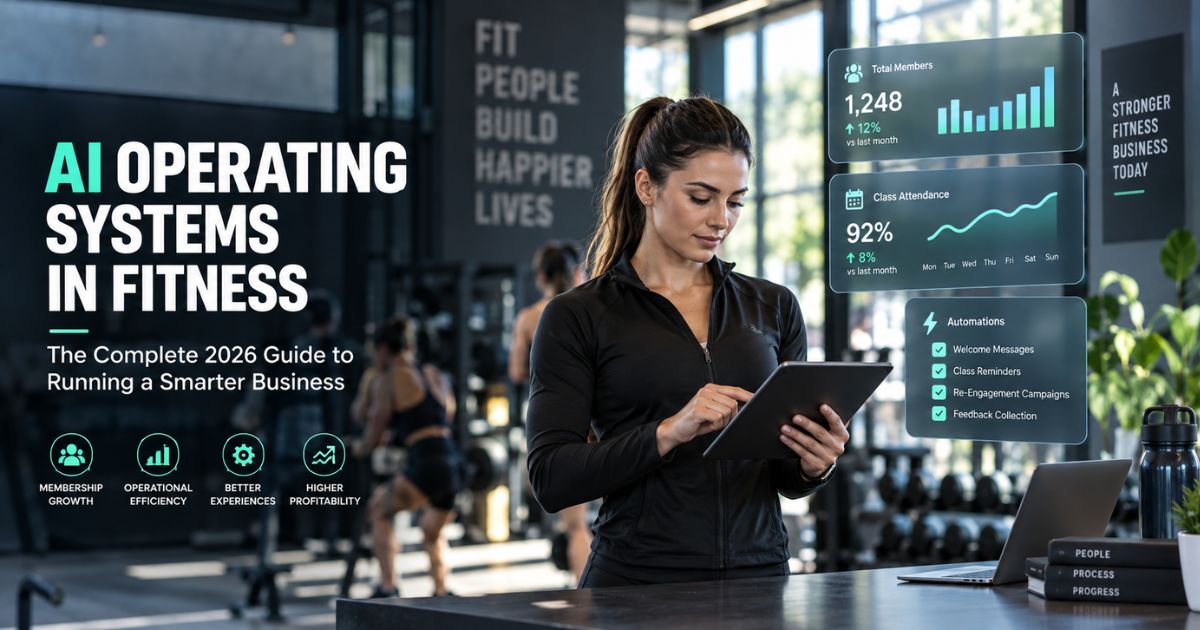
AI Operating Systems in Fitness: The Complete 2026 Guide to Running a Smarter Business
If you run a gym, yoga studio, wellness center, or personal training business, you've probably noticed something. AI operating systems in fitness are changing how modern businesses manage their day-to-day operations. Software companies used to call themselves “booking software” or “membership tools.” Now they call themselves an AI operating system. This means a single smart platform that connects your business data, automates routine tasks, and helps you make better decisions. It doesn't just store your data. It acts on your data.
So what does this actually mean? Does your fitness business need one? This guide explains what an AI operating system is. It shows how it's different from the tools you use now. And it tells you what to look for before you switch.
What Is an AI Operating System?
Think about Windows or iOS. These are operating systems. They sit under every app on your device. They make hardware and software work together. An AI operating system does the same thing for a business. It's one platform where every task runs together: scheduling, billing, messages, staff management, and reports. All the data is shared. And an AI layer sits on top. It studies that data all the time. It makes decisions and suggestions in real time.
Here's the key difference. A normal system tells you what already happened. An AI operating system predicts what will happen next. It tells you what to do about it. And it does this before you even ask.
This matters a lot for fitness businesses. A spreadsheet can tell you a member hasn't shown up in two weeks. That's it. An AI operating system does more. It flags that member as a high churn risk. It looks at their behavior, payments, and engagement to make that call. Then it can suggest or even write a personal message to win them back.
Why Fitness Businesses Are Adopting AI Operating Systems Now
A few things are pushing gyms, studios, and wellness centers toward AI faster than most other small businesses:
- Keeping members matters most. Getting a new member costs much more than keeping one you already have. But most studios only notice a member is gone after they've already quit.
- Teams are stretched thin. Front-desk staff, trainers, and owners are already busy. They chase renewals, send reminders, and track payments by hand.
- Members expect personal touches. People use Netflix and Spotify. Both apps recommend things just for them. Members expect the same from the businesses they pay every month.
- Scattered tools hide problems. Bookings live in one app. Payments live in another. Messages happen on a personal WhatsApp. No single system sees the whole picture. So no one spots a warning sign before a member leaves for good.
An AI operating system fixes all four problems at once. It brings the data together, and it acts on it.
The Core Parts of an AI Operating System for Fitness Businesses
Not every tool that says "AI" actually deserves the label. A real AI operating system for a gym or studio needs these parts. And they need to work together, not sit bolted on as extras:
1. One Shared Data Layer Every booking, payment, visit, and message lives in one system. This is the foundation. AI can only find patterns in data it can actually see. If bookings sit in one app and payments in another, no AI can connect the dots.
2. Churn Prediction Most systems only notice a member left after their card stops getting charged. A good system is different. It flags at-risk members early, based on their behavior, payments, and engagement. This gives staff a chance to step in before that member leaves.
3. Automatic, Personal Messages Once the system flags a risk (or an opportunity), it can help. Depending on how advanced the platform is, it might suggest a message, help write one, or send it automatically. Either way, the message matches that specific member. It's not a generic blast sent to everyone.
4. Revenue Forecasting You shouldn't have to wait until month-end to know your cash position. An AI operating system predicts future revenue. It looks at current memberships, bookings, payments, and renewal trends. This lets owners plan staffing, promotions, or growth using real numbers instead of guesses.
5. AI-Powered Business Insights This kind of AI can spot unusual patterns. It notices declining engagement, emerging risks to revenue, and other changes worth your attention.
6. Smart Scheduling AI can also predict demand. It spots classes or time slots that aren't being used enough. And it suggests better scheduling across trainers, instructors, and rooms.
What It Looks Like in Practice
The theory matters less than the result. Here's what an AI operating system actually changes, day to day, for a fitness business owner:
- A gym owner opens a morning alert. It lists 12 members with a high chance of quitting. Each one comes with a suggested message to send. The owner learns this today, not next month when the cancellations already happened.
- A yoga studio spots classes that aren't full. It sees demand patterns too. This helps managers make smarter choices about scheduling and space.
- A wellness center runs physiotherapy, spa, and nutrition services under one roof. It gets one revenue forecast covering all three. No more stitching together three separate spreadsheets.
- A gym chain with many locations compares churn risk and revenue across every branch. All from one dashboard. No more asking each location manager for a separate report.
The real value comes from catching problems early, reaching members in a way that fits them, doing less manual admin work, and seeing your business more clearly.
The Evolution: From Spreadsheets to AI Operating Systems
It helps to understand how fitness businesses got here. This shows why "AI operating system" isn't just old software with a new name:
- Phase 1 — Pen, paper, and spreadsheets. Membership lists live in Excel. Attendance gets tracked on a clipboard. Payments get tracked by hand. This works fine for a handful of members. It breaks down past a few hundred.
- Phase 2 — Single-purpose software. Now there are dedicated booking tools, separate payment processors, and a messaging app used casually. This is better organized. But the data stays split apart. No tool sees the full picture of a member.
- Phase 3 — All-in-one platforms. Booking, billing, and customer tracking merge into one system. Reports get better. But the software still just reacts. It shows you what already happened, not what's coming.
- Phase 4 — AI operating systems. This is where we are now. Data lives in one place, and a predictive AI layer sits on top. It flags risk, forecasts revenue, and triggers action on its own. The platform stops being just a record-keeper. It becomes an active partner in running the business.
Most fitness businesses today sit in Phase 2 or Phase 3. The gap is growing between those businesses and the ones that have already moved to Phase 4.
How AI Helps Different Kinds of Fitness Businesses
AI brings different value depending on your business type. Here's how the same AI technology applies across different formats:
Gyms and Fitness Clubs Chains with many branches use AI to compare churn risk, equipment use, and revenue across locations. All from one dashboard. No manual reports needed from each branch manager. Locker and equipment use patterns also help with staffing and space decisions.
Yoga and Pilates Studios AI spots when a class isn't full. It predicts demand and suggests scheduling changes, instead of letting a mat sit empty. It also tracks instructor performance and class-pack renewals automatically. This helps studios decide which class formats to keep or drop.
Personal Trainers and Coaches With fewer clients, every cancellation hurts more. AI notices when a client is showing up less often, or when their package is about to expire. This gives the trainer time to reach out personally. AI also handles invoicing, so the trainer isn't chasing payments between sessions.
Wellness Centers, Spas, and Physiotherapy Clinics Some businesses run several services at once — physio, spa, and nutrition. An AI operating system combines revenue forecasts and staff scheduling across all of them. It also matches clients with the right trainer or wellness professional. It looks at skills, availability, goals, and fit, instead of scheduling everything by hand.
Dance Academies and Martial Arts Schools AI connects class scheduling to student progress. It flags when a student is ready to test or move up a level. It also automates messages to parents about fees, recitals, and attendance. This matters a lot in youth programs, where parents need frequent updates.
Sports Clubs and Shuttle Courts AI tracks court use in real time. It flags underbooked courts and busy hours. This lets an owner run a quick promotion to fill a slow Tuesday afternoon, instead of noticing the lost money next month.
ROI: What an AI Operating System Actually Saves You
AI features are only worth it if they change your numbers. Three areas usually show the clearest payoff:
1. Keeping members, not just finding new ones. Keeping a current member costs much less than finding a new one. Even a small boost in renewals — catching members before they leave instead of after — usually outweighs the cost of the software itself.
2. Hours of admin work saved. Automatic reminders, invoices, and waitlist management free up hours of front-desk work every week. That time turns into either cost savings or more time spent on sales and member experience.
3. Fewer missed chances to earn revenue. The system catches problems early — a sudden wave of cancellations, an empty time slot — while there's still time to fix them. Instead of noticing after the money is already lost.
When you weigh the cost, compare the subscription price to two things: the admin hours you'll save, and the value of members you'll keep who would have otherwise quietly left. Don't just compare it to the price tag of your old tools.
Data Security and Privacy Considerations
An AI operating system naturally brings more of your business data into one place. This includes member contact details, payment info, and health or session notes. That makes security a real factor to check, not an afterthought:
- Look for recognized security standards, like SOC 2 or GDPR readiness. This matters especially if you handle EU member data or sensitive health notes, like physiotherapy or nutrition records.
- Check how payments are handled. Trustworthy platforms send card and UPI payments through certified processors, like Razorpay or Stripe. They shouldn't store card data themselves.
- Understand who owns your data. Make sure you can export your member and financial data if you ever switch platforms. A real operating system shouldn't trap your data.
- Ask how the AI uses your data. Predictions should come from your own business's data. They shouldn't get mixed together with other customers' information.
Common Myths About AI Operating Systems
"AI will replace my staff." In practice, AI removes repetitive admin work — sending reminders by hand, spotting patterns in spreadsheets, chasing invoices. This frees up staff to focus on member relationships and sales, the things that actually need a human touch.
"It's only worth it for large chains." Churn prediction and automatic reminders may matter even more for a single small studio. Why? Because that owner doesn't have a data analyst. Without AI, they're trying to spot these patterns by hand.
"Switching means a long, painful process." Before you switch, ask about data transfer, onboarding, support during setup, and how long it takes before your team can use it well.
"More AI features always mean a better platform." A long feature list doesn't mean much if your data is still scattered across different tools. The real test: does the AI act on data from your whole business? Check the list of questions below.
The Future of AI Operating Systems in Fitness
A few trends are already taking shape:
- Deeper personalization. AI-generated workout or program changes based on a person's attendance and progress. Not just messages about renewing.
- Voice and chat tools. Owners will ask their business questions directly ("how's this month's revenue tracking?") instead of digging through dashboards.
- Smarter staffing predictions. AI will suggest trainer and instructor schedules based on predicted demand, not just past bookings.
- Comparing businesses. Anonymous data will let owners see how their retention or space usage compares to similar businesses nearby.
The common thread: AI keeps moving from reporting, to recommending, and eventually to acting on its own. A human still makes the final call. But now they start several steps ahead of where they used to be.
How to Evaluate an AI Operating System Before You Switch
If you're comparing platforms, ask these questions. Don't just trust the label "AI-powered":
- Does the AI use shared data, or is it bolted onto separate tools? If bookings, billing, and messages aren't already in one system, the "AI" is probably just a report generator.
- Does it predict, or just describe? Ask for a real example of a prediction, like churn risk, not just a chart on a dashboard.
- Can insights turn into action? An insight is only useful if it leads somewhere — a message, a reminder, a filled waitlist spot. Otherwise, the work still falls on your staff.
- Does it work across locations? If you plan to open a second location, make sure the AI works across branches from day one. Not as something added later.
Final Thoughts
The phrase "AI operating system" gets thrown around loosely in software marketing right now. But for fitness businesses, the shift underneath it is real. Platforms that combine scheduling, payments, messages, and reports — then use AI to predict churn, forecast revenue, and automate outreach — are replacing the old mix of spreadsheets, WhatsApp threads, and single-purpose apps most studios still rely on.
Here's the clearest way to know if you need one: if you only find out a member is gone after they've already left, you're running on plain software. If your system warns you before they leave — and helps you act on it — you're running on an AI operating system.
Fitzpot brings booking, memberships, billing, staff management, and AI insights — like churn prediction and revenue forecasting — into one connected platform. It's built for gyms, studios, and wellness businesses. Start a free 14-day trial or book a live demo to see it running on your own data.