
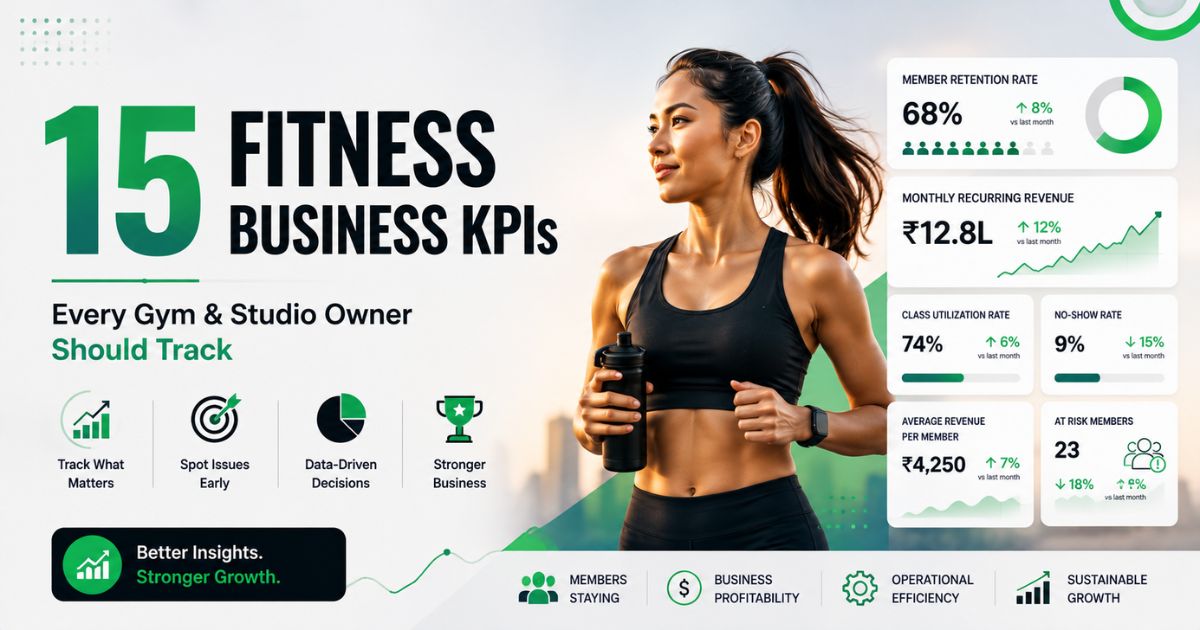
15 Fitness Business KPIs Every Gym & Studio Owner Should Track
Introduction
Running a gym or studio without tracking fitness business KPIs is like coaching a client without ever checking their progress — you're guessing, not managing. Yet many fitness businesses still rely on membership counts and monthly revenue alone, missing the operational metrics that reveal problems before they affect profitability. Those numbers tell you what happened. They don't tell you why, and by the time a problem shows up in revenue, it's usually been building for weeks.
Fitness KPIs (key performance indicators) fix that. They're the small set of numbers — retention, churn, class utilization, revenue per member — that act as an early-warning system for your business. Track them consistently, and you catch a slipping renewal rate or an underbooked class while it's still a five-minute fix, not a five-figure problem.
This guide breaks down the 15 KPIs that matter most for gyms, studios, and wellness businesses, organized into three groups: whether members are staying, whether the business is actually profitable, and whether day-to-day operations are running efficiently. For each one, you'll get a clear definition, how to calculate it, and why it matters.
Why Fitness KPIs Matter More Than Vanity Metrics
Total membership count feels good to report, but it hides the real story. A gym adding 40 new members a month while losing 35 is running hard to stand still. KPIs matter because they:
- Reveal problems while they're still small and fixable
- Turn "the vibe feels off this month" into a specific, actionable number
- Let you compare performance across classes, trainers, or locations
- Give you a baseline to measure the ROI of any change you make
With that framing, here's what to actually track.
Member Retention & Growth KPIs
1. Member Retention Rate
The percentage of members who stay over a given period. Calculated as:
((Members at end of period − New members acquired) / Members at start of period) × 100
Industry benchmarks for gyms typically sit between 60–70% annual retention, though boutique studios with strong community can push higher. Retention is the single most important number in a membership business — a 5% improvement in retention can lift profitability far more than a 5% increase in new sign-ups, because retained members cost nothing to reacquire.
2. Churn Rate
The inverse of retention — the percentage of members who cancel or lapse in a given period. Churn is worth tracking monthly, not just annually, because it lets you catch a bad month before it becomes a bad quarter. Segmenting churn by membership type, join date, or attendance frequency often reveals patterns (e.g., members who don't visit in their first two weeks churn at much higher rates).
3. Member Acquisition Rate
How many new members you're signing up per month or per marketing channel. This KPI is only useful alongside retention — acquisition without retention is a leaky bucket.
4. Net Promoter Score (NPS)
A simple "how likely are you to recommend us?" survey score. NPS correlates strongly with long-term retention and referral volume, and it's one of the few KPIs that captures member sentiment before it shows up in the cancellation numbers.
5. Referral Rate
The percentage of new members who came from an existing member's recommendation. High referral rates are a strong signal of genuine member satisfaction, and referred members typically retain better than members acquired through paid ads.
Financial & Revenue KPIs
6. Average Revenue Per Member (ARPM)
Total monthly revenue divided by active members. Tracking this over time shows whether you're growing revenue through more members, or through better monetization (upsells, add-ons, retail, PT sessions) of the members you already have.
7. Monthly Recurring Revenue (MRR)
The predictable revenue from active memberships, excluding one-off purchases. MRR is the clearest indicator of financial stability for any subscription-based fitness business and is essential for cash flow planning.
8. Customer Lifetime Value (LTV)
The total revenue a member generates over their entire relationship with your business. Calculated roughly as ARPM × average membership length in months. LTV should always be compared against acquisition cost — if it costs more to acquire a member than they're worth, growth is actively losing money.
9. Customer Acquisition Cost (CAC)
Total marketing and sales spend divided by new members acquired in that period. A healthy fitness business typically wants LTV to be at least 3x CAC.
10. Late Payment / Failed Payment Rate
The percentage of billing cycles with a failed or overdue payment. This one is easy to ignore until it's costing thousands a month. Automated billing and payment reminders (UPI, card, or auto-debit) typically bring this number down significantly compared to manual invoicing.
Operational & Efficiency KPIs
11. Class/Session Utilization Rate
(Attendees / Total capacity) × 100
Tracked per class, per trainer, or per time slot. Low utilization at a specific time reveals scheduling problems; consistently full classes signal where to add capacity.
12. No-Show Rate
The percentage of booked sessions or classes where the member simply doesn't turn up. No-shows waste capacity that could've gone to someone on a waitlist, and they're one of the most responsive metrics to fix — automated reminders alone typically cut no-show rates by 20–40%.
13. Staff Utilization Rate
For PT-heavy or appointment-based businesses (physiotherapy, salons, coaching), this tracks how much of a staff member's available time is actually booked. Low utilization means either overstaffing or a scheduling/marketing gap.
14. Lead-to-Member Conversion Rate
Of the trial visitors, walk-ins, or leads captured, what percentage convert to paying members? This connects your marketing funnel directly to revenue and highlights whether the problem is lead volume or sales/onboarding execution.
15. Average Visit Frequency
How often an active member actually shows up per week or month. This is a leading indicator of churn — members whose visit frequency drops are often at increased risk of cancelling if engagement isn't restored.
How to Actually Track These KPIs Without a Spreadsheet Nightmare
Tracking 15 KPIs manually across memberships, class rosters, and payment records is exactly the kind of admin work that eats a Saturday and still ends up out of date. In practice, most growing fitness businesses consolidate this into a management platform that pulls attendance, billing, and membership data into one dashboard automatically — so retention rate, churn, and utilization update in real time instead of at the end of the month.
Platforms like Fitzpot combine Executive Dashboards, AI Membership Intelligence, Revenue Intelligence, Predictive Analytics, and Operational Analytics into a single Wellness Intelligence Platform. Rather than simply displaying KPIs, the platform identifies trends, predicts risks, and recommends actions that help businesses improve retention, optimize operations, and increase profitability.
Conclusion
You don't need to track all 15 KPIs perfectly from day one. Start with the three that predict trouble earliest — retention rate, churn rate, and no-show rate — because they're leading indicators, not lagging ones. Once those are under control, layer in the financial metrics (ARPM, MRR, LTV vs. CAC) to make sure growth is actually profitable, not just busy. Round it out with the operational KPIs (utilization, staff efficiency, conversion rate) to find the specific gaps costing you capacity and revenue every week.
The pattern across all 15 is the same: every one of them turns a vague feeling — "renewals seem slow," "that class feels emptier lately" — into a specific number you can act on before it becomes a real problem. That's the actual value of tracking fitness KPIs. It's not about having more data for its own sake; it's about catching the small, fixable issues weeks before they show up as a bad month in your revenue report.
The businesses that grow predictably aren't simply tracking more KPIs—they're using Business Intelligence to understand what those numbers mean and AI-powered insights to act before small issues become costly problems.